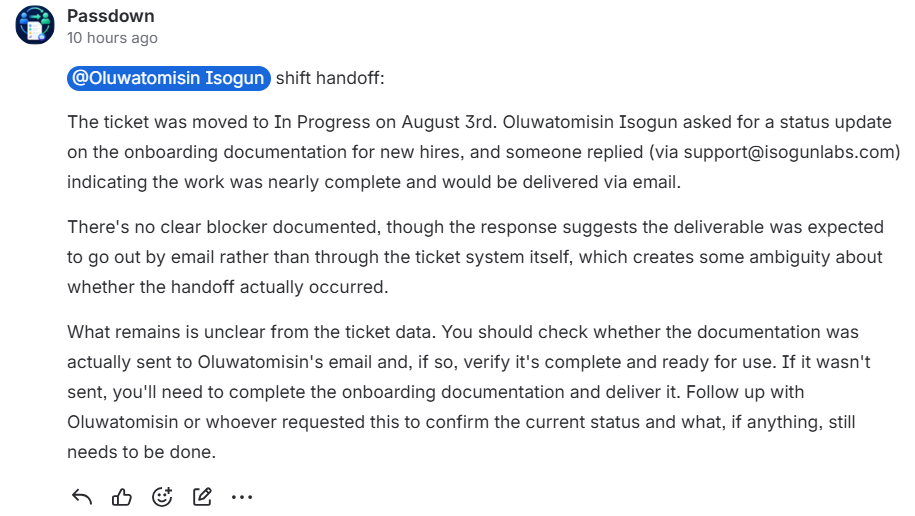
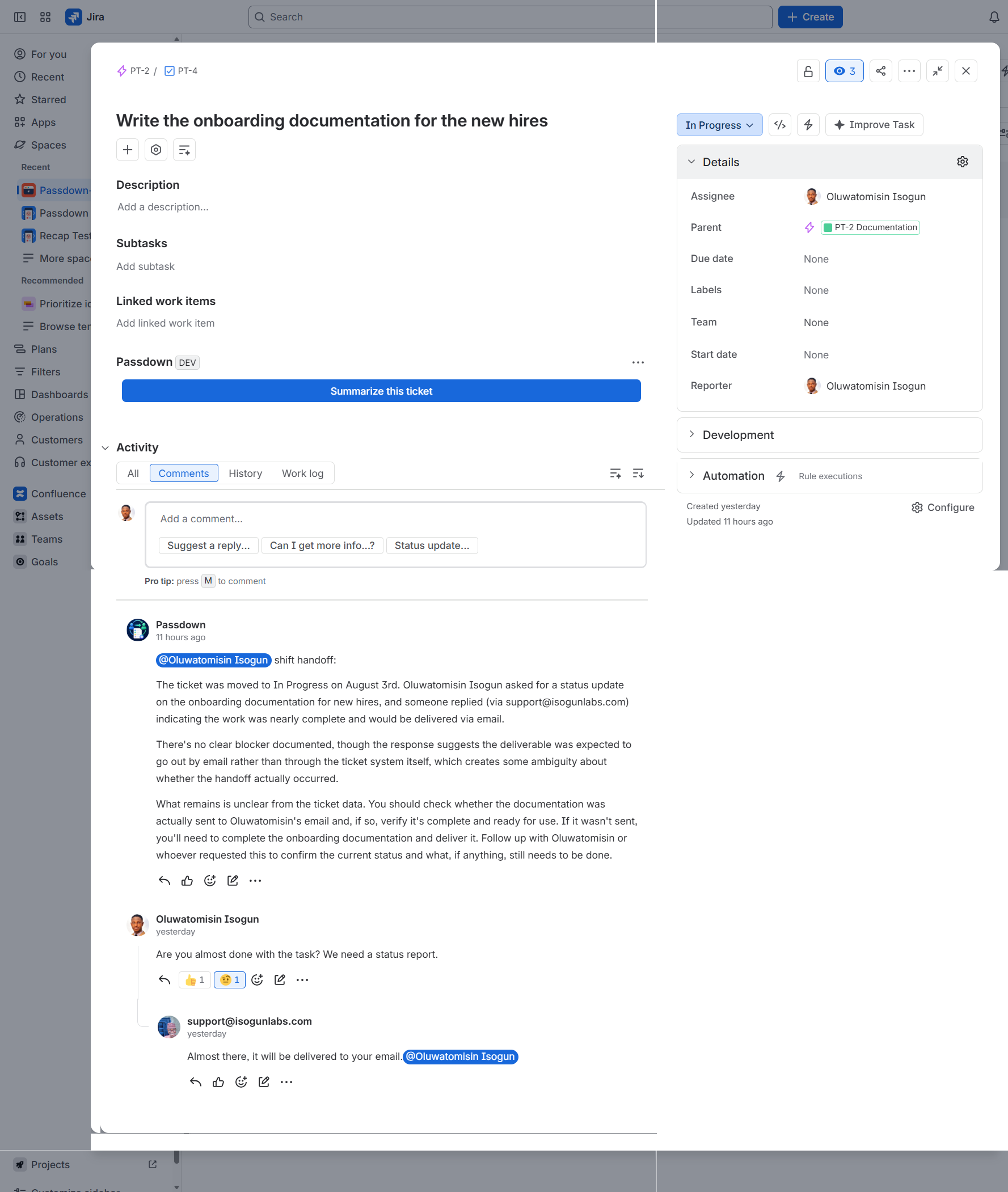
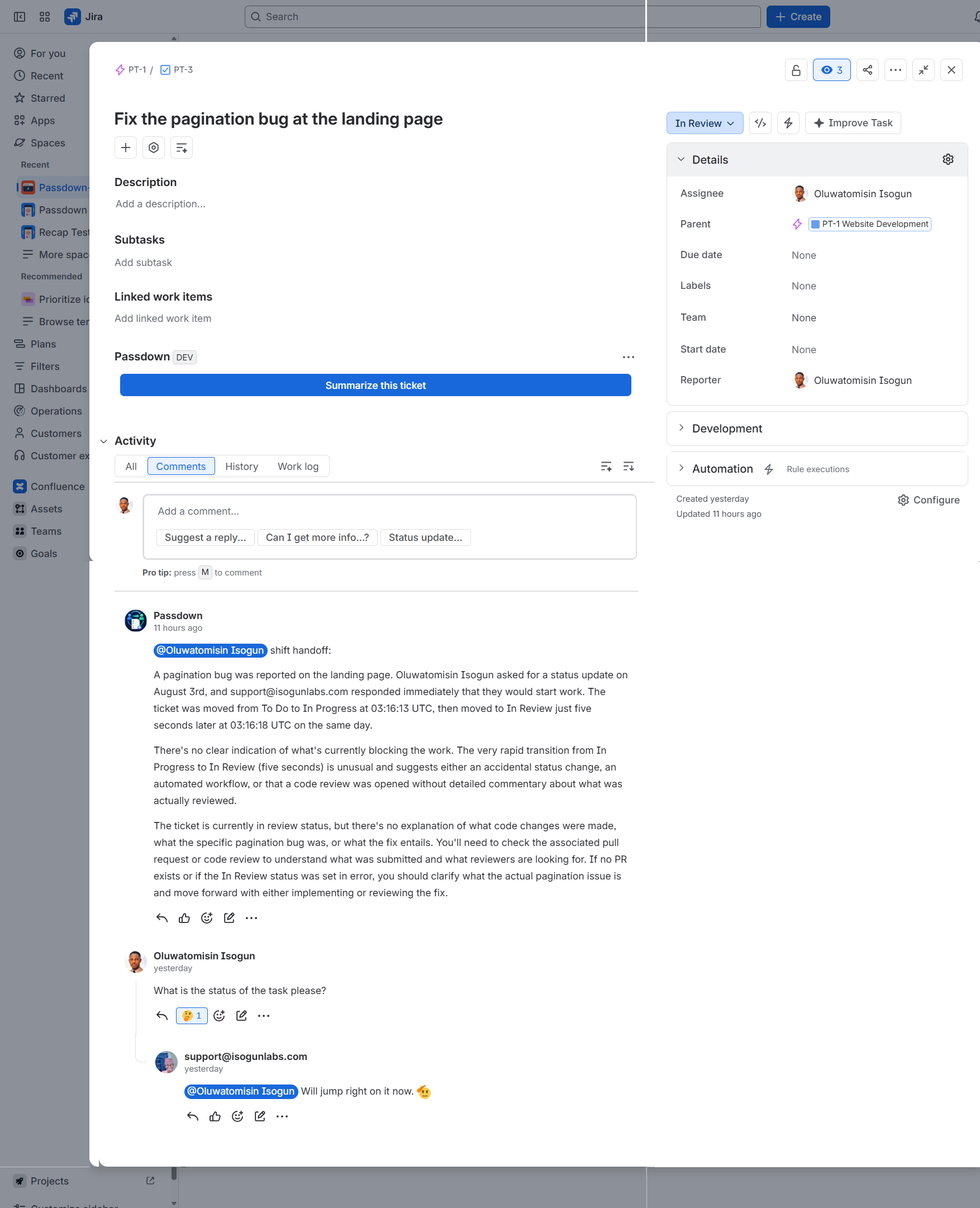
When a shift ends, Passdown reads what actually happened — the tickets worked, what's blocking, what's next — and writes the handoff itself. Posted as a comment, the incoming person mentioned and the ticket reassigned. No one has to remember to leave a note.
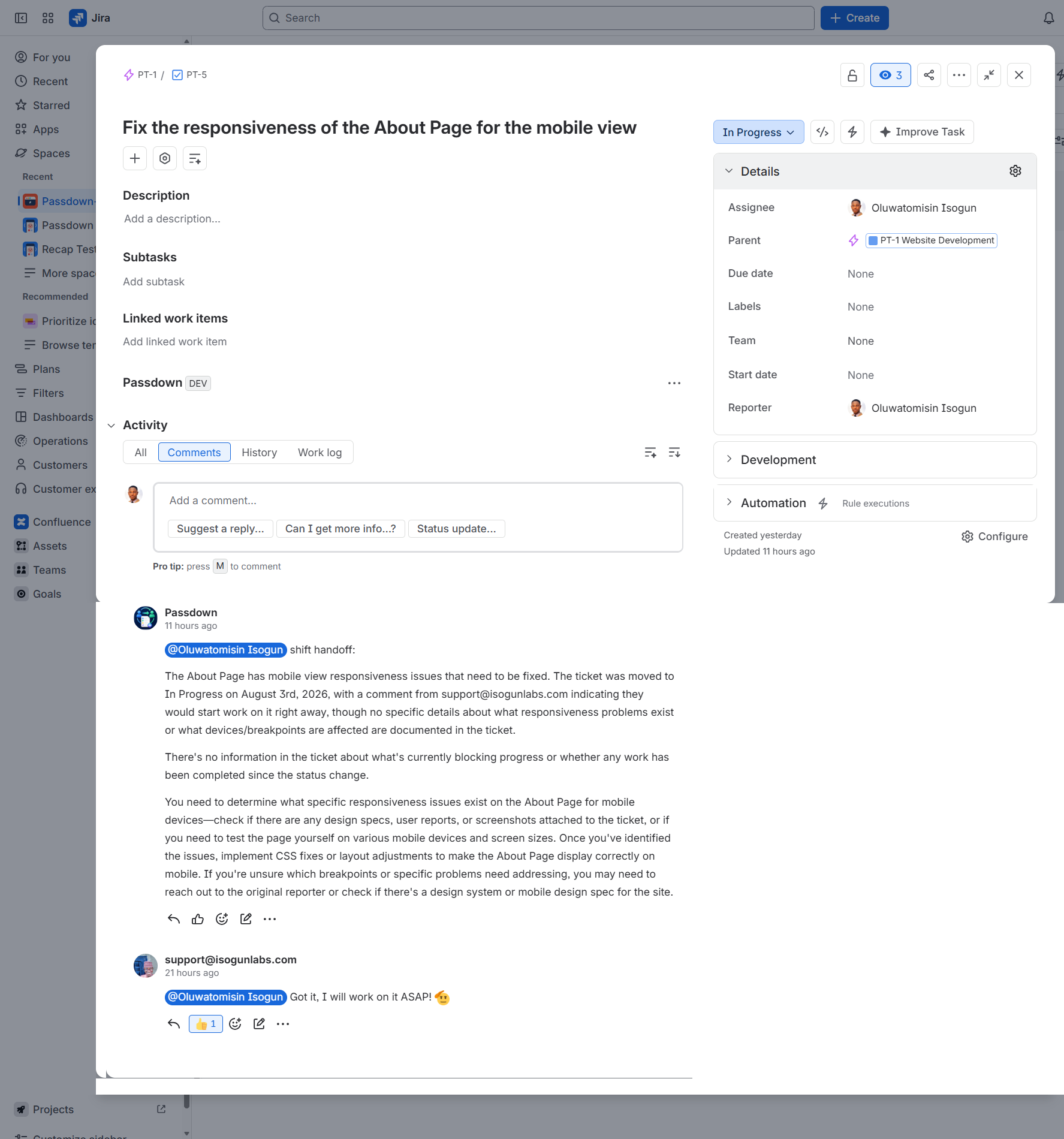
Captured straight from a real shift boundary — nothing staged.
No manual step from the outgoing agent — Passdown watches the schedule you already maintain and writes the handoff the moment it changes.
Read straight from JSM's native on-call schedule — no separate rotation to configure.
Every open ticket the outgoing person had gets a plain-language summary: what happened, what's blocking, what's next.
The incoming person is @-mentioned and the ticket is reassigned to them — a guaranteed signal, not just a hopeful notification.
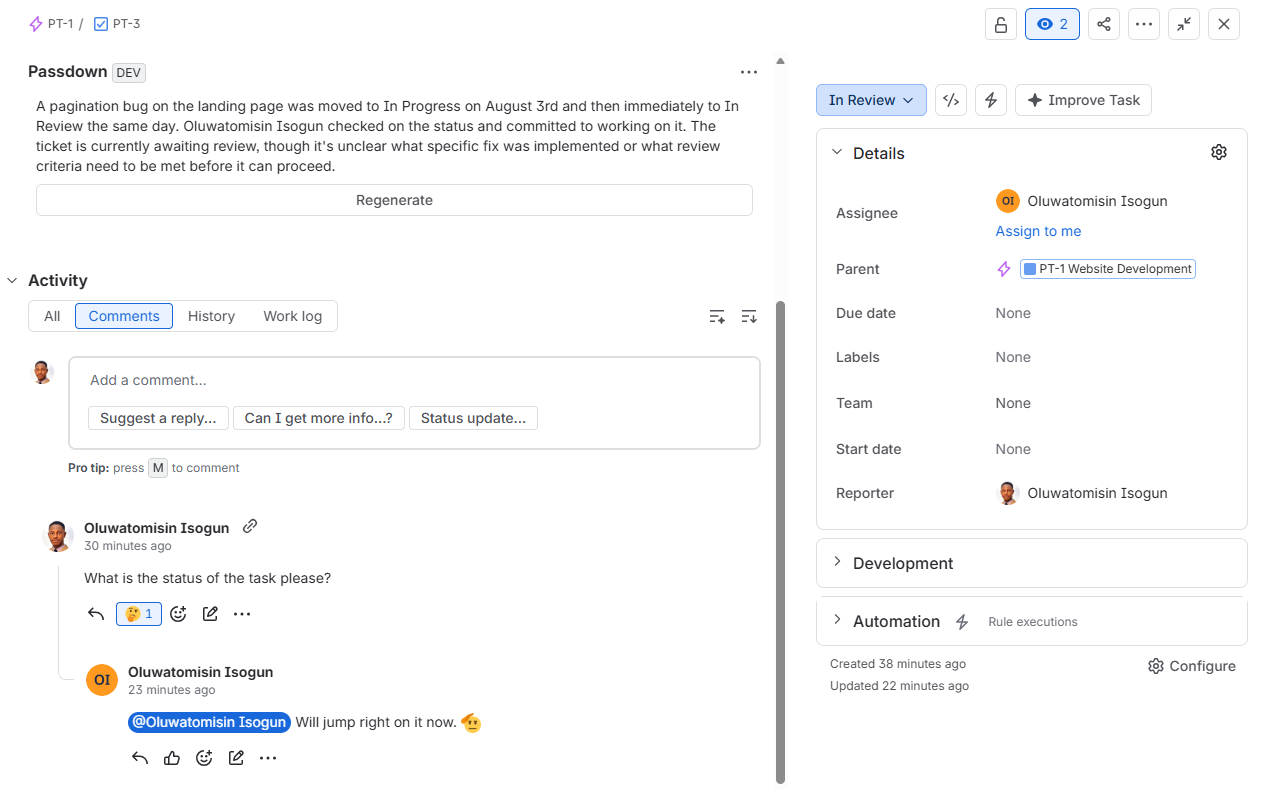
One outgoing person, one shift change — Passdown found every open ticket they had and wrote the handoff for each, on its own, in the same pass. These are unedited screenshots of that run.
No one opened this ticket to write it.
Not "someone" — mentioned by name, on the ticket.
Its own history, not a shared template.
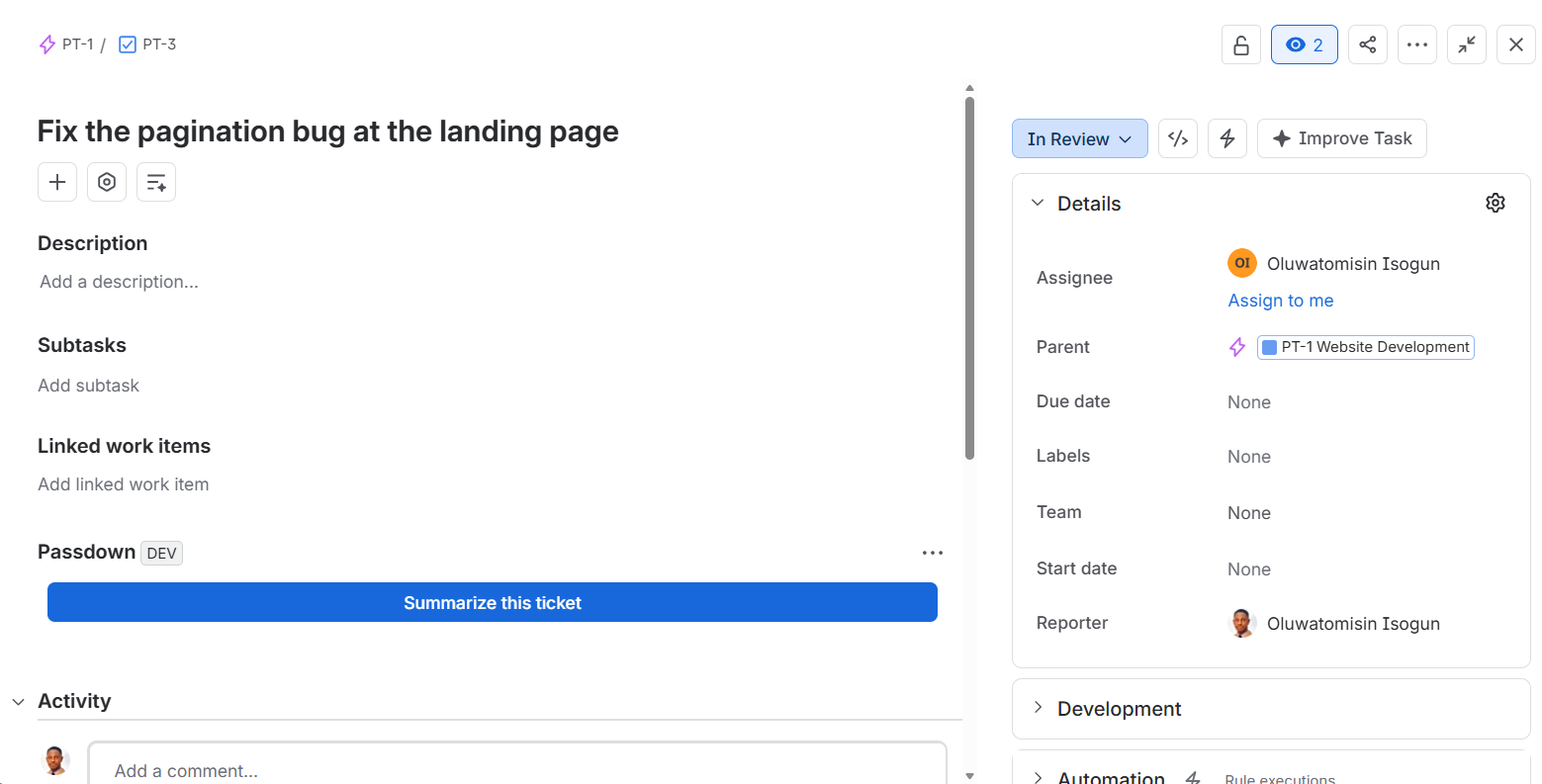
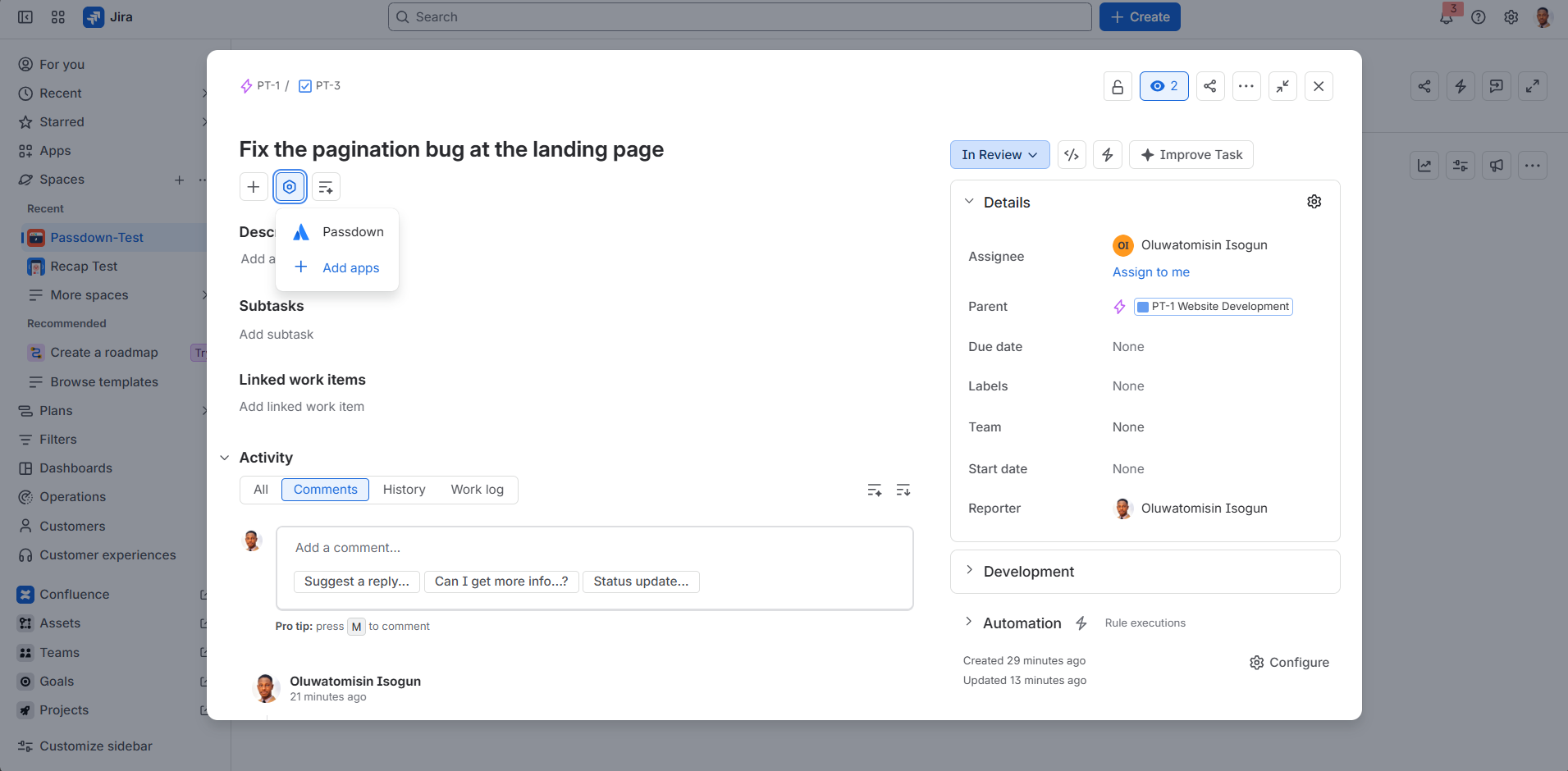
Whole-shift automation is the flagship. The same engine also runs on a single ticket, on demand.
Anyone catching up on a single ticket — mid-shift, after time off, or picking up an escalation — can get the same plain-language summary from a panel on that ticket, without waiting for a shift boundary.
No invented details, no rebuilt scheduling, no growing storage.
No button to click at shift end. The brief is written and posted on its own.
The brief reflects what the ticket's own history says — no fabricated status or metrics.
The incoming person is reassigned the ticket, not just mentioned — a signal that can't be missed.
Only ever one small record per on-call schedule, overwritten each check — never a growing history.
No. Passdown reads the on-call schedule you already maintain in Jira Service Management — it never builds or competes with rotation or delegation logic.
That schedule is skipped for automatic handoffs — there's no single incoming person to assign or mention. This is a known, current limitation, not a silent failure; it's visible in the app's logs.
Not yet. Slack and Teams push is planned as a future, explicitly opt-in admin setting — off by default and not part of the current build. See Documentation.
Ticket content needed to write a summary, and one small record per on-call schedule (who's currently on-call) so it can detect the next change. See the privacy policy for detail.
Passdown is in Atlassian Marketplace review. Leave your email and we'll let you know the moment it's available to install.